E-commerce & sport pro : booster l’expérience fan avec Shopify
Modernising sports e-commerce: how Shopify is driving growth for professional sports clubs.







The professional sports sector is undergoing a profound transformation. Whilst in the past fan engagement took place mainly within the stadium itself, today’s fans demand a constant and personalised relationship, particularly through the digital platforms that surround them (social media, ticketing, e-commerce, etc.). We have entered the era of Fan Experience 3.0: a unified, emotional and seamless digital and physical customer relationship, where merchandising is no longer merely a source of ancillary revenue, but the very heart of the club’s identity and a strategic lever for monetisation to boost clubs’ turnover.
Having long been constrained by ageing or overly rigid e-commerce systems, professional sports clubs now recognise that their online shop has become a major and essential channel, and have made optimising it a priority for the fan experience. A look at the e-commerce sites of the biggest clubs reveals that digital performance has become the essential foundation for serving sports fans.

The Fan 3.0: an emotionally driven consumer
Before being a supporter, a fan is a consumer. And like any online shopper, their expectations are, above all, high when it comes to the fundamentals of e-commerce. Whether they are a sports enthusiast or follow every feat of a professional athlete, their expectations are clear:
- Logistics and delivery: speed and reliability are key purchasing criteria, almost as important as price;
- Trust and transparency: data privacy and brand authenticity are crucial;
- Seamless omnichannel retailing: consumers switch between their mobile phones, their computers and the stadium shop. They expect a consistent experience everywhere, all the time.
Unlike the average consumer, the fan is driven by emotion when making a purchase. They are not simply buying a product; they are buying a symbol, an identity, an unbreakable bond with their club. Their expectations are therefore heightened:
- Authenticity and a sense of belonging: the product must reflect the club’s values and history;
- Exclusivity and scarcity: 40 per cent of fans say they are more likely to buy if the product is limited edition;
- Personalisation: the product must be unique and reflect the customer’s own relationship with the club; in fact, 33 per cent of buyers of official shirts opt for the version personalised with their name;
- Enhanced omnichannel retailing: the digital experience must be linked to the place where passion thrives – the stadium.

4 gaps in experience that are holding back club growth
The question is no longer whether e-commerce is strategic, but whether clubs’ current platforms are truly capable of delivering the agility, omnichannel capability and emotional intensity required to enhance the fan experience. Operational friction is the main obstacle to business growth. These issues centre on four key areas of disruption that directly undermine performance and the fan relationship:
01
Phantom stock and the illusion of
omnichannel retailing
The crux of the problem lies in the inability to ensure that stock levels are accurate and updated in real time across the online shop, the physical shop and the pop-up shops. The consequences are immediate: lost sales, high levels of customer dissatisfaction due to order cancellations, and an increased workload for staff in managing errors and refunds.
02
The fragmented fan identity and the breach of the promise of loyalty
This scenario is directly linked to the system’s inability to identify the fan (via SSO, for example) in order to automatically apply their benefits (subscriber discounts, gift cards) across all purchasing channels. This results in customer frustration, which undermines the promise of loyalty, and weakens the sense of belonging created by any special status.
03
Management by guesswork and an unmeasurable ROI
We are referring here to the lack of integrated and interconnected analytical tools across the club’s systems to pinpoint specific data (relating to a campaign, e-commerce performance, online/offline, etc.). The direct consequences can be disastrous: poor budget management, an inability to optimise margins and replicate successes, thereby limiting growth and strategic decision-making.
04
Operational dependency and loss of agility
The problem arises from the need to call on a third-party service provider for urgent tasks (such as changing visuals or setting up a pop-up till) due to the platform’s lack of autonomy and flexibility. This leads to a costly dependency, a critical lack of responsiveness on match days, and an inability to capitalise on last-minute commercial opportunities.

Shopify: the solution for a seamless, fan-first experience
Over the last few years, Shopify has established itself as the go-to CMS amongst professional sports clubs in France and across Europe. This trend is largely driven by the world of football, a pioneer in e-commerce; clubs have realised that merchandising is much more than just a stadium shop: it is a major strategic revenue driver.
It is therefore no coincidence that Shopify stands out in this area: the platform specifically addresses the sector’s critical features and has established itself as the most sophisticated solution for unifying the fan experience.
- Unified retail and omnichannel: Shopify breaks down silos by synchronising the online shop, physical shops and pop-up stores in real time. This centralised management ensures accurate stock levels and a consistent customer experience, everywhere and at all times;
- Scalability and a comprehensive ecosystem: with two major releases a year (over 600 new features!) and a rich ecosystem of applications, the tool enables you to meet a wide range of business needs. It is the ideal tool for ‘test and learn’: deploy, test and innovate without any technical hassle, so you can always stay at the forefront of e-commerce trends;
- Performance and scalability: as well as being recognised for having the best-performing checkout on the market, Shopify guarantees overall technical robustness. The platform handles massive volumes of traffic and orders (on match nights, during kit launches) whilst maintaining full availability;
- Autonomy for greater agility: in an industry driven by the sporting calendar, results and emotion, Shopify offers clubs complete independence. Marketing teams can manage launches and content without relying on third parties, even during critical peak periods.
Shopify and Webqam to transform your online shop
By choosing Shopify, clubs gain access to a top-tier tool capable of transforming every interaction with fans into a driver of sustainable growth. The platform provides clubs with the infrastructure of a major retail brand, allowing them to focus on what matters most: fan engagement, diversifying their collections and expanding the brand. It guarantees a digital solution that grows alongside the club’s ambitions.
At Webqam, our role as a Shopify agency and integrator goes beyond mere technical implementation. We bring in-depth industry knowledge to address the specific challenges faced by sports clubs, ensuring that the power of an e-commerce platform is aligned with your operational realities.
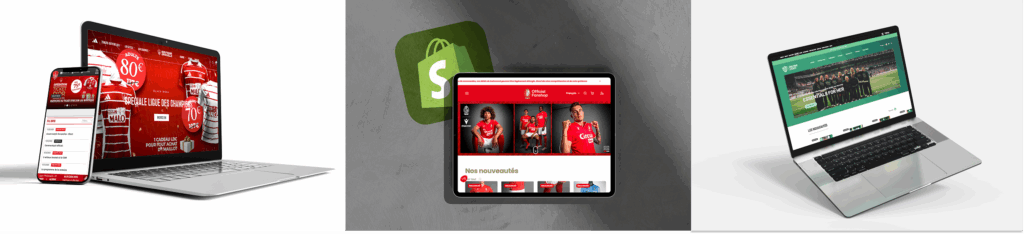
A number of French and European clubs have already chosen to place their trust in us to drive the digital transformation of their e-commerce ecosystem: ASSE, Standard de Liège, Stade Brestois