Retour sur la 6ème
édition d’A11Y Paris :
une journée d’engagement
pour l’accessibilité numérique
A summary of a packed and inspiring day for organisations, businesses and experts in digital accessibility.

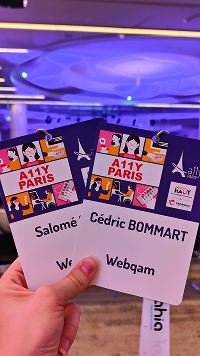
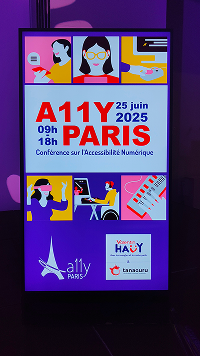
On 26 June, the 6th edition of the A11Y Paris conference took place at the Salons de l’Aveyron. The event brought together more than 40 speakers and workshop leaders to discuss a crucial issue: digital accessibility. It was a packed and inspiring day, during which organisations, businesses and experts shared their findings, key figures, initiatives and proposals for action.
Opening: ‘Not just a matter of compliance’
The day began with an introduction that set the tone: accessibility must not be reduced to a regulatory obligation. Nicolas Pesquidous (Crédit Agricole) emphasised that accessibility is, above all, a right – the right to equal access to information for all. Today, only 30 per cent of online services are accessible; there is still a long way to go. The law acts as a catalyst for achieving compliance. “We support every customer, whatever their circumstances,” he said. “Every individual must have equal access to our websites, whether they are a customer or a member of staff.”
Developers, designers and decision-makers have a crucial role to play: incorporating accessibility considerations at an early stage so that everyone can overcome digital challenges.
Key figures: accessibility in banking and e-commerce
Katie Durand and Denis Boulay, from the French Federation of the Blind and Visually Impaired, presented the findings of their monitoring programme. Their study is based on what websites state about their accessibility, rather than on the accuracy of the information published.
Their objectives are as follows:
- To highlight the lack of consideration given to the needs of users who are distrustful
- Identify the sectors requiring particular attention
- Measuring progress
In June 2025, out of 7,309 sites inspected, only 264 complied with the display requirements (i.e. approximately 3 per cent). The public sector is not setting a good example: 202 sites complied with the display requirements out of the 5,938 sites inspected (also approximately 3 per cent).
In private banking, the figures speak for themselves: 132 organisations were audited, and none were found to be fully compliant. The e-commerce sector presents a similar picture: 610 member organisations of the FEVAD were analysed, including websites offering all types of products; clothing and accessories, home and décor, food and gastronomy, and health and beauty are the four main sub-categories. And once again, none are compliant. The observatory is a real catalyst for raising awareness within the Federation; over the coming year, they aim to optimise the tool by introducing new features. Watch this space…
Source: The Observatory’s website
Digital accessibility: an evolving legal framework
Nicolas Rohfritsch (Hogan Lovells) provided a detailed explanation of the European directives:
- WAD (2016/102/EU) on public websites and certain private websites and apps (with an annual turnover of over 250 million in France). Unfortunately, the stakeholders have proved resistant and reluctant to take action.
- The EAA (2019/882/EU) on the accessibility of products and services will come into force this Saturday, 28 June 2025. As of 2023, the transposition of the EAA into French law is already running nearly 15 months behind schedule. All new products or services must comply with the regulations and be comprehensible to a person with a level of French equivalent to B2. In the event of non-compliance, the penalty under the EAA is a 5th-class fine (€7,500), with increases in the event of repeat offences and potential additional daily charges (amount not specified).
E-commerce websites must also provide information relating to the usability of products (e.g. instructions, etc.).
As both of these texts are still in force, both Acts remain applicable; in other words, the EAA does not replace the WAD.
As regards the regulatory bodies, there will be five in France: the DGCCRF, the AMS, the ACPR, the ARCEP and the ARCOM, each of which will intervene depending on the sector of activity.
As a reminder, public access buildings and B2B websites are not affected.
Charities are not directly affected, except for those that rely on public funding, in which case they must ensure they are accessible.
What role does the DGCCRF play?
Jessica Ramani confirmed that, depending on the sector in which the site operates, the DGCCRF may be authorised to carry out inspections either on its own or in collaboration with another regulatory body. She also confirmed the DGCCRF’s inspection process:
- Warnings issued via an official letter to highlight breaches
- Letters of formal notice setting out deadlines for compliance
- Criminal penalties, which are made public (up to €15,000 for a natural person, €75,000 for a legal person). A penalty applies to only one website or application.
- The DGCCRF would like to remind you that, in the event of an inspection of a compliant site, no report or summary will be issued.
In 2025, the DGCCRF will continue its programme in the transport sector; in 2026, other sectors will be the focus of its inspections. It will also examine all reports submitted via Signal Conso.
The teams are versatile and specialise by sector, but face a shortage of human and technical resources. The DGCCRF is currently developing a tool to enable them to carry out audits more quickly. They are also training a proportion of their auditors in digital accessibility, although they emphasise that this is not a requirement for analysing accessibility statements or audit reports.
With regard to multilingual websites within Europe, the DGCCRF confirms that discussions are underway with the authorities of Member States to harmonise procedures.
The Act of 28 June 2025 is not intended to amend the provisions on accessibility in service contracts. However, this will be the case in 2030.
The RGAA is evolving: version 5.0, for example, is expected to incorporate mobile functionality.
ARCOM Roadmap
Laurence Pecaut Rivolier outlined the progress made by the media regulator:
- Are responsible for regulating audiovisual media services, e-books and e-reader software
- The 22 reports received led to 22 interventions by ARCOM. All the companies contacted took action.
ARCOM is working with the DGCCRF and the DINUM to develop a monitoring tool that will enable them to continue and step up their inspections. The target is 2,000 inspections per year.
ARCOM also publishes answers to the questions most frequently asked by listeners in order to improve understanding and analysis of the texts.
AccessibilityOps: how can we scale up?
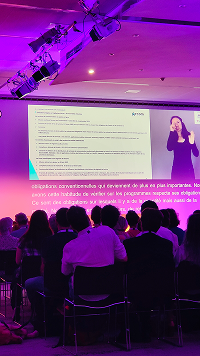
Anne-Sophie Tranchet (Beta.Gouv) presented the strategy put in place to raise awareness and build consensus on accessibility by challenging common misconceptions:
- "Accessibility is not compatible with the way our organisation is structured."
- "Accessibility – we don’t know how to go about it"
- "We'll sort out accessibility, but later"
She ultimately asks herself: ‘Do we need accessibility experts in every team?’ and comes to the conclusion that this could create a negative dynamic and a loss of knowledge, and that it isn’t feasible for very small teams. Her objective becomes to help (many) people develop their skills (a little). Large-scale awareness-raising has proved a failure; a smaller, highly actionable and practical knowledge base ultimately enables everyone to learn how to ask the right questions when faced with accessibility issues, in the knowledge that there won’t necessarily be an expert at their side. Making accessibility visible through three key approaches: KPIs and reporting to convince senior management at strategic moments; short, light-touch in-person sessions; and regularly sharing industry updates and engaging content on staff networks.
She also highlights the limitations of the RGAA, which is not particularly representative in terms of the actual cost of audits. Automated tests are often unsuitable. She encourages a focus on evaluating the user experience instead. An overly strict inspection protocol can be off-putting; she proposes the introduction of Easycheck workshops: a document analysing just three pages is enough to spark a discussion. For example, we will be talking much more about relevance and criticality rather than the validity of a criterion. We need to strike the right balance between ‘blocking’ and ‘annoying’.
As a result, many audits receive a score ranging from ‘poor’ to ‘adequate’, as the RGAA does not reflect the realities on the ground.
She sums it up: the role of Accessibility Ops is five roles in one! And above all, avoid perfectionism, which can be a misguided approach to accessibility.
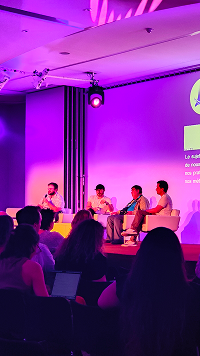

How is the e-commerce sector organised?
A very practical round-table format bringing together:
- SNCF Connect & Tech: a blind person comes in one day a week to test real-world routes. This is a way of bringing disability to life and ensuring that interfaces are compliant and usable.
- Carrefour: Accessibility has been incorporated into the 2026 plan, with the introduction of a scheme to keep staff informed. From this year onwards, user tests will be 100 per cent customer-focused.
- Leboncoin: training for 200 staff members (across the design, front-end, iOS and Android teams). An audit kicked off the process, but without in-house training, it was impossible to take it any further and define the necessary actions.
- Fnac Darty: similar issues to those faced by Leboncoin. We need to raise awareness amongst all staff, so that every employee becomes an ally of accessibility.
Businesses must make a long-term commitment to charitable organisations. But that is not enough: there must also be support from senior management, a strategic plan and a budget; otherwise, nothing will happen.
The Design System is presented as a catalyst for getting initiatives off the ground. However, it remains very difficult to quantify the return on investment (ROI) as it requires patience: people with disabilities do not immediately switch to newly accessible interfaces. They first need to change their habits.
It is essential to centralise expertise and integrate it into all processes: otherwise, staff turnover could result in the loss of all that knowledge. Timing is also a key factor in ensuring that departments can secure and access budgets at the right time.
There are then several different approaches. SNCF Connect & Tech is keen to be audited by an external body every year in order to remain proactive and avoid a mountain of non-compliance issues, which can be demotivating. Leboncoin, on the other hand, wishes to bring the audit process in-house as the allocated budgets are not flexible.
Digital accessibility and the banking sector
- La Banque Postale: is trialling a voice-activated credit card.
- BNP, Société Générale & Crédit Mutuel: pooling of ATMs under the Cashservices brand.
- CB is also working on developing an accessible payment terminal.
They also all share a common cross-cutting issue: current communications are too complex. The law requires that documents be understandable to anyone with a B2 level of language proficiency. We need to switch to the FALC method (Easy to Read and Understand).
The next step for everyone: driving change.
REX from a relevant contact: TF1
Kevin Bustamante, digital accessibility lead at TF1 and himself visually impaired, shares a powerful personal account:
“Digital technology is a real catalyst for independence. It must therefore be accessible.”
Through the story of his career path, he explains the challenges of becoming a trainer and technical support specialist to assist the universities and lecturers with whom he is a student.
Companies want to make progress but don’t know how. All too often, it is people with visual impairments who are expected to adapt, when it should be the other way round. Raising awareness within companies is easier; people are receptive and understand the benefits:
- Weekly workshops lasting no more than 30 minutes
- Questioning the obvious: ‘What is accessibility? Will this be of interest to you?’
- Make deliverables accessible, whether on Jira, Figma or elsewhere
- Prioritise usability over the ‘wow’ factor; aim for simplicity
“We’re fed up with waiting; it’s time to take action, and quickly,” he says. He also offers some advice to accessibility coordinators:
- Set regular targets
- Presenting accessibility in a positive and effective way inspires people to take action
Fence
Representatives from the A11Y Paris organisation have finally spoken out about the changes to come within the association. Collective action is gaining momentum, organisations are evolving, but there is still much to be done. The 6th edition of A11Y Paris has shown one thing: solutions do exist; we must now put them into practice to enable everyone to navigate the web and access information on an equal footing.